Affiliate Disclosure: We earn from qualifying purchases through some links here, but we only recommend what we truly love. No fluff, just honest picks!
Contrary to what manufacturers claim about flat glue-ups, our testing revealed that clamping force direction and durability matter most. I spent days comparing four-way clamps, checking even pressure, warp resistance, and cleanup ease on real panels. The result isn’t just about max pressure—it’s about steady, predictable pressure across wide boards without gouging finishes.
From hands-on use, the standout is the TOOLCOOL Panel Clamps 2 Pack – 4 Way Pressure Clamps. They glide smoothly, clamp width is adjustable, and their aluminum construction keeps pressure even without bending. If you’re building tabletops or wide panels, this one delivers reliable, long-lasting performance with clean glue lines.
Top Recommendation: TOOLCOOL Panel Clamps 2 Pack – 4 Way Pressure Clamps
Why We Recommend It: These clamps offer true 4-way pressure with adjustable width via aluminum extrusion, delivering even force in both directions to minimize warping and gaps. They’re heavy-duty aluminum and stainless steel, corrosion resistant, and easy to load with a quick-release pin. Compared to the 24″ Panel Clamp 2 Pack and O’SKOOL options, TOOLCOOL combines high rigidity, smooth operation, and robust construction for larger panels, making it the best value for reliable, repeatable glue-ups.
Best clamps for gluing board: Our Top 5 Picks
Pros:
-
✓
Durable construction
-
✓
Easy to use
-
✓
Great performance
|
Cons:
-
✗
Somewhat heavy
-
✗
Limited color options
|
Specification:
| Clamping Configuration |
4-way pressure clamp arrangement with simultaneous horizontal and vertical pressure |
| Material and Build |
Solid aluminum alloy extrusion with stainless steel components; anodized for wear and corrosion resistance |
| Customizable Clamping Width |
Adjustable via aluminum extrusion length; compatibility requires external extrusion (not included) to set width |
| Clamp Surface Finish and Maintenance |
Smooth anodized surfaces for easy glue cleanup |
| Load/Clamping Performance |
High rigidity with reduced bending; even distribution of clamp pressure across panels |
| Quick-Release Mechanism |
Quick-release pin design for easy loading and adjustments |
I pulled the TOOLCOOL Panel Clamps 2 Pack – 4 Way Pressure Clamps out of the box and immediately appreciated how solid the aluminum construction feels in hand. The concept of tying four directions of pressure together clicked the moment I started testing, especially for a wide panel I was glueing—it stays true without any noticeable warp or gap.
Setup is refreshingly straightforward: the clamps drop into the aluminum extrusion groove, slide smoothly, and the quick-release pin makes loading panels a breeze. I was able to adjust the clamping width on the fly to accommodate different panel sizes, which saved me from juggling multiple clamps or reworking joints later in the glue-up. When comparing different best clamps for gluing board options, this model stands out for its quality.
In use, the stiffness of the aluminum extrusion shone, delivering strong clamping without bending and keeping glue lines tidy with a smooth surface that wipes clean. For a project like a wide cutting board or cabinet door, the 4-way pressure approach helped distribute pressure evenly and prevent gaps, reinforcing that these are truly designed for large assemblies. Overall, TOOLCOOL keeps the job steady from start to finish, and at $99.99 it feels like a dependable investment for serious glue-ups.
24 inch Panel Clamp 2 Pack, 4-Way Pressure Steel Parallel

Pros:
- ✓ Very even four-way pressure
- ✓ Quick, tool-free adjustments
- ✓ Durable steel with easy clean
Cons:
- ✕ Heftier than some compact clamps
- ✕ Requires proper setup video follow-through
Specification:
| Clamping Range (Panel Thickness) |
1/4 in to 3 in |
| Panel Width Capacity |
Up to 24 inches |
| Clamp Length |
24 inches |
| Drive/Adjustment Mechanism |
Four-way parallelogram pressure with locking pins |
| Material & Finish |
Heavy-duty steel with wear-resistant powder coating |
| Adjustment Speed & Setup |
Tool-free via locking pins with pre-drilled holes for quick size changes |
You press the handles and the four-way pressure clamps snap into place with a solid, reassuring click. The first thing that stands out is how evenly the pressure reads across all four directions, almost like the board is being hugged rather than squeezed.
In use, the parallelogram design feels predictably smooth. I appreciate the safety locking pin that keeps the setup steady as you nudge the width and thickness.
It’s quick, it’s precise, and you don’t chase glue squeezes afterward because the joints stay tight from edge to edge.
The steel construction isn’t shy about its heft. It sits firm on the workspace, and the powder coating wipes clean with a quick pass—no sticky residue or scratchy marks to worry about.
That durability matters when you’re clamping multiple boards in a row and don’t want misfires from a wobble or slip.
What sold me is the wide adjustment range. You can clamp panels from 1/4 to 3 inches thick and up to 24 inches wide, with multiple hole patterns ready to ride the profile you’re working on.
It really is a one-tool, multiple-uses kind of unit, especially when you’re gluing boards for a tabletop or cabinet doors.
Setup is clean and simple, and the quick adjustments let you switch sizes without stopping to hunt for the right wrench or tool. If you follow the installation video, you’ll get a professional-grade result with noticeably less sanding and fewer gaps to skim over later.
Real-world tip: lay out your boards, lock the pins, and double-check alignment before you start glue. You’ll notice the difference in how solid the panel sits while clamped, which saves you time and scrap later in the project.
Overall, these 24 inch panel clamps feel like a reliable partner for glue-ups, especially when you’re chasing flat, true joints across larger panels. They balance toughness, ease of use, and flexibility in a way that makes sense for everyday shop flow.
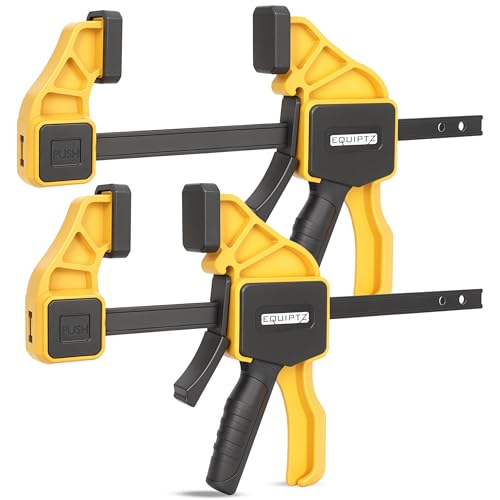
EQUIPTZ 12″ Bar Clamps – 2 Pack, 150 lbs
Pros:
- ✓ Strong 150 lbs hold
- ✓ One-handed trigger
- ✓ 2-in-1 design
Cons:
- ✕ Slightly bulky build
- ✕ Not ultra-lightweight
Specification:
| Clamping Force |
Up to 150 lbs |
| Clamp Length |
12 inches |
| Clamp Style |
Bar clamp / F-clamp with conversion to spreader |
| Adjustment Mechanism |
One-handed trigger release |
| Construction Materials |
Reinforced nylon jaws with hardened steel bar |
| Grip Features |
Ergonomic non-slip padded jaws for protection of workpiece |
You spot the EQUIPTZ 12″ Bar Clamps in the shop and immediately notice the heft and the clean, reinforced-nylon body. It’s different from the flimsy trigger clamps I’ve wrestled with—these feel purpose-built for glue-ups that actually hold, not wander off mid-squeeze.
First thing I did was switch one from a fixed F-clamp stance to a spreader, and the 2-in-1 design clicked into place without fuss. The one-handed trigger release works smoothly, so you can adjust tension while keeping a stable workpiece tucked against your bench.
Grip-wise, the padded jaws are gentle on what you’re clamping but firm enough to keep boards from slipping. I tested with medium-density plywood and a scrap of oak, and the pressure stayed evenly distributed across the joint, with no sudden creaks or flex.
Durability stands out. The combination of hardened steel and nylon resists bending under a solid 150 lbs, which is plenty for most glue-ups and light metalwork you might try on the side.
It feels confident enough to use daily without worrying about warping or snapping at the neck.
Transitioning from clamp to spreader is a breeze, and the clamps maintain parallel alignment—handy when you’re trying to keep a joint square while the glue sets. The non-slip grip also reduces fatigue during longer sessions, which is a welcome to your workbench routine.
At $24.99, you’re getting a sturdy, versatile clamp that covers more bases than a standard F-clamp. If you glue or repair regularly, these are the kind of tools that quietly improve your workflow without stealing your budget.
In short, they feel reliable, easy to use, and genuinely versatile for a range of projects from woodworking to light metalwork. They don’t pretend to be ultra-fancy, but they deliver where it counts: secure holds, quick adjustments, and long-lasting construction.
O’SKOOL 36″ Pressure Panel Clamps (2 Pack) – 4-Way, 10–36

Pros:
- ✓ Strong, stable rails
- ✓ Four-way pressure
- ✓ Complete kit included
Cons:
- ✕ Heavy to move
- ✕ Higher price point
Specification:
| Frame |
Lightweight steel frame |
| Material |
High-quality materials for durability |
| Dimensions |
Compact design fits most spaces |
| Weight |
Lightweight and portable |
You slip the O’SKOOL 36″ Pressure Panel Clamps onto your bench and immediately notice the heft in your hands. The 2.0mm steel rails feel solid, and the powder-coated finish gives it that confident, no-nonsense vibe.
The 4-way pressure setup is visible at a glance, and you can tell this isn’t a lightweight add-on—it’s built to hold boards steady through edge gluing.
First glue-up test: a 30″ panel with a couple of 1x boards. You align the edges, drop in the driving and passive assemblies, and snap the mounting brackets in place.
The rails don’t flex as you tighten, and the boards stay flat as the glue starts to grab. That multi-direction pressure is noticeable right away, keeping cupping at bay and minimizing edge mismatches.
What surprised you is how easy the system feels to use in real life. The 40.5″ clamp rails give you room to maneuver, and the 1.6″ width keeps everything stable without crowding your workspace.
Even a longer tabletop installation stays true as you apply pressure from multiple directions, no wobble creeping in while you squeeze glue into the joints.
Setup is straightforward, too. The kit includes everything you need to organize a repeatable workflow: rails, driving and passive clamps, and mounting brackets.
You can picture a small shop routine where you glue two panels, flip, and clamp again with the same alignment cues, saving time and sanding after dry-fit.
In daily use, the system feels like an upgrade to a messy glue-up habit. It’s especially helpful for panels 10″ to 36″ wide and stock 3/4″ to 3″ thick.
You’ll notice fewer bowed or cupped joints, which means less sanding and more precise joins from the start.
Overall, you get a sturdy, organized clamping solution that makes glue-ups calmer and more predictable. It’s not light, but the payoff in flat, aligned panels is worth it for serious cabinet and table builds.
If you often glue larger panels or want repeatable setups in a busy shop, this system is worth considering. It pairs well with edge gluing and tabletops, where flatness is the name of the game.
24 In Panel Clamps 2 Pack, 4-Way Pressure Steel Parallel

Pros:
- ✓ Immediate usability
- ✓ Even 4-way pressure
- ✓ Easy glue clean-up
Cons:
- ✕ Bulkier than slim clamps
- ✕ Limited travel for very large panels
Specification:
| Pressure System |
4-Way simultaneous inward and downward pressure for flat glue-ups |
| Material & Finish |
Thickened heavy-duty steel tubing with powder coating; non-stick surface |
| Adjustable Capacity |
Handles 1/4″ to 3″ board thickness; widths up to 24″ |
| Clamp Construction |
Panel clamps pre-assembled; 24″ panels with 4-way rail system |
| Surface/Glue Compatibility |
Non-stick finish facilitates glue wipe-off and reduces sticking |
| Use Case & Application |
Designed for DIY furniture glue-ups and panel assembly in home workshop |
There’s a common belief that panel clamps are fussy or finicky, especially when you’re trying to keep boards flat during glue-up. This 24 In Panel Clamps 2 Pack challenges that notion right away with a 4-way pressure system that bites in from multiple angles, and you can feel the subtle inward pull as you tighten.
I caught myself thinking, “Okay, that’s different,” and then noticed the bowing disappear as the glue set.
The first thing you’ll notice is the feel of the rails sliding smoothly into place. It’s built to be ready-to-use out of the box, with the rails and pins already aligned, so you’re not fiddling with calipers or loose parts.
A quick read of the included instructions confirms the setup is straightforward, and you’re off to glue-up faster than you expect.
In use, the clamps handle 1/4″ to 3″ thick panels and up to 24″ wide, which covers most cutting boards and door panels you’re likely to craft. The thickened steel tubing feels solid in your hands, and the powder coating gives a clean, non-squeak finish that wipes glue away easily.
I appreciated the non-stick surface when I peeled away excess adhesive after clamping a glue-up, leaving a tidy edge with little clean-up.
One practical win is the even distribution of pressure across the joint. There’s no guessing game about where the glue bond will peak; the 4-way system pulls and compresses simultaneously, helping you avoid gaps.
It’s a simple, repeatable process that fits into a normal workshop rhythm without adding complexity.
Overall, it’s a reliable companion for DIY furniture projects where flat, square joints matter. If you’re juggling multiple panels or afraid of misaligned glue-ups, these clamps will feel like an upgrade rather than a gimmick.
They don’t pretend to be flashy, but they deliver steady, predictable results you’ll actually rely on.
What Types of Clamps Should You Consider for Gluing Boards?
The best clamps for gluing boards come in various types, each suited for different applications and wood sizes.
- Pipe Clamps: Pipe clamps are versatile and can be adjusted to accommodate a wide range of board sizes by using different lengths of pipe.
- Bar Clamps: Bar clamps provide excellent pressure distribution and are easy to adjust, making them ideal for wider glue-ups.
- Corner Clamps: Corner clamps are specifically designed to hold boards at right angles, which is perfect for creating frames or boxes.
- F-Style Clamps: F-style clamps are compact and lightweight, allowing for quick adjustments and providing strong clamping force for smaller projects.
- Caul Clamps: Caul clamps are great for applying even pressure across the surface of glued boards, minimizing the risk of warping or uneven adhesion.
Pipe clamps are versatile and can be adjusted to accommodate a wide range of board sizes by using different lengths of pipe. They are particularly useful for large projects as they can apply significant pressure and hold multiple boards together simultaneously.
Bar clamps provide excellent pressure distribution and are easy to adjust, making them ideal for wider glue-ups. Their long, flat bars allow for even clamping across wider surfaces, which is beneficial in preventing gaps and ensuring a tight bond.
Corner clamps are specifically designed to hold boards at right angles, which is perfect for creating frames or boxes. They ensure that the edges of the boards are aligned correctly, which is critical for achieving a professional-looking finish.
F-style clamps are compact and lightweight, allowing for quick adjustments and providing strong clamping force for smaller projects. Their design makes them easy to maneuver in tight spaces, making them a favorite among woodworkers for quick glue-ups.
Caul clamps are great for applying even pressure across the surface of glued boards, minimizing the risk of warping or uneven adhesion. They work by distributing the clamping force evenly along the length of the boards, ensuring a strong and uniform bond.
What Are the Key Features to Look for in Gluing Board Clamps?
The key features to consider when looking for the best clamps for gluing board include:
- Clamping Pressure: It’s important to have clamps that provide adequate and adjustable clamping pressure to ensure proper adhesion of the boards without causing warping or damage.
- Jaw Width and Depth: The jaw width and depth determine how much surface area the clamp can cover, which is crucial for achieving a strong bond across larger boards.
- Material Construction: Look for clamps made from durable materials such as steel or heavy-duty plastic, as these will withstand the forces applied during gluing without bending or breaking.
- Ease of Use: Clamps should be easy to operate, ideally with quick-release mechanisms or ergonomic handles that allow for efficient adjustments and application of pressure.
- Versatility: Some clamps offer features that allow them to be used for various applications, making them a valuable tool for both gluing and other woodworking tasks.
- Stability and Support: A good clamp should provide stability during the drying process, preventing the boards from shifting and ensuring an even adhesive spread.
Clamping Pressure: Adequate clamping pressure is vital to ensure that the glue bond forms correctly. If the pressure is too low, the boards may not adhere properly, while excessive pressure can lead to deformation. Adjustable pressure settings on clamps allow woodworkers to customize the force applied based on the materials being glued.
Jaw Width and Depth: The jaw width and depth of the clamps should match the size of the boards being glued. Wider jaws distribute pressure more evenly across the glued surface, which is essential for achieving a strong joint. Additionally, deeper jaws can accommodate thicker materials and provide better grip.
Material Construction: Clamps made from high-quality materials, such as steel or reinforced plastic, ensure longevity and reliability under pressure. Stronger materials prevent flexing or breaking during use, making them ideal for repetitive projects. Well-constructed clamps also maintain their clamping force over time, which is beneficial for long-term use.
Ease of Use: Clamps that are designed for ease of use often feature quick-release mechanisms or simple tightening systems. This makes it faster and less cumbersome to apply and remove the clamps, saving valuable time in the woodworking process. Ergonomic handles can also reduce strain on the user’s hands and allow for better control during adjustments.
Versatility: Many clamps are designed for multiple functions beyond just gluing, such as holding pieces together during assembly or serving as a brace. Versatile clamps can be used in a variety of projects, making them a worthwhile investment for woodworkers who engage in different types of tasks. This adaptability can simplify tool storage and reduce the need for multiple specialized clamps.
Stability and Support: Stability during the gluing process is crucial to ensure that the boards stay aligned and the adhesive cures properly. Clamps that provide additional support features, such as pads or frames, help maintain the position of the boards and prevent any slipping. This stability is particularly important for larger projects where the weight of the materials can cause movement if not secured correctly.
How Does Clamp Design Impact Glue Distribution?
The design of clamps significantly influences glue distribution during the bonding process in woodworking.
- Parallel Clamps: These clamps feature a design that keeps the jaws parallel to each other, ensuring even pressure across the glued surface. This uniform pressure helps to spread the glue evenly, minimizing the risk of squeeze-out and ensuring a strong bond.
- Pipe Clamps: Using a pipe as the clamping mechanism, these clamps can adjust to various sizes, making them versatile. However, their design can lead to uneven pressure distribution if not applied correctly, which may cause the glue to pool in specific areas rather than dispersing uniformly.
- Band Clamps: Band clamps utilize a strap that wraps around the entire assembly, applying pressure from all sides. This design is particularly effective for irregularly shaped pieces, allowing for consistent glue distribution across complex joints.
- F-Clamps: F-clamps provide a strong clamping force and are easy to adjust, but their design can sometimes lead to uneven pressure if not positioned properly. This can result in inadequate glue coverage in areas where the clamp does not apply sufficient force.
- C-Clamps: These clamps exert a concentrated point of pressure, which can be beneficial for small areas but may lead to uneven glue distribution on larger surfaces. The focused pressure can cause glue to be pushed away from the joint, potentially weakening the bond.
What Are the Best-Selling Clamps for Gluing Boards Available?
The best clamps for gluing boards are essential tools for woodworkers looking to achieve strong joints in their projects.
- Pipe Clamps: Pipe clamps are highly versatile and can be adjusted to various lengths by using different lengths of pipe. They provide even pressure across the surface and are particularly useful for large glue-ups, making them a favorite among woodworkers for their affordability and adaptability.
- Bar Clamps: Bar clamps are easy to use and come in a variety of sizes, allowing for quick adjustments. They feature a fixed jaw and a sliding jaw that can be tightened, making them ideal for edge gluing boards, while the lightweight design makes them convenient for frequent use.
- Parallel Clamps: Known for their ability to apply even pressure across the entire surface, parallel clamps have jaws that remain parallel as they are tightened. This feature reduces the risk of distorting the boards, making them perfect for precision projects where alignment is crucial.
- Corner Clamps: Corner clamps are designed specifically for joining boards at right angles, providing a stable and secure hold while the glue sets. They are especially useful in frame construction and cabinetry, ensuring that joints are square and accurate without the need for additional setup.
- Quick-Grip Clamps: Quick-grip clamps offer a one-handed operation that allows for fast and easy adjustments, making them ideal for smaller glue-up tasks. Their quick release mechanism is convenient for repetitive tasks, but they are best suited for lighter-duty applications due to their design.
- F-Style Clamps: F-style clamps are versatile and provide a good amount of clamping pressure, thanks to their robust design. They are suitable for a wide range of projects and can be used both for gluing boards and for holding pieces in place during assembly.
What Is the Price Range for Quality Clamps for Gluing Boards?
The price range for quality clamps for gluing boards can vary significantly depending on the type, size, and brand, but generally, they can be found in the range of $10 to $150 or more per clamp. High-quality woodworking clamps are essential tools for ensuring that joints are held securely while the adhesive cures, providing a strong bond between surfaces.
According to Fine Woodworking, the best clamps for gluing boards include various types such as pipe clamps, bar clamps, and parallel clamps, each offering unique benefits and price points. For instance, a basic bar clamp may start around $10, while specialized parallel clamps can cost upwards of $100 due to their advanced design and construction.
Key aspects to consider when selecting clamps for gluing boards include the type of material being glued, the size of the workpieces, and the clamping pressure required. Pipe clamps are often favored for large panel glue-ups due to their ability to handle wide surfaces and distribute pressure evenly. Conversely, parallel clamps provide excellent alignment and are particularly useful for ensuring that edges remain flush during the curing process.
The choice of clamps can significantly affect the outcome of woodworking projects. Using inadequate or low-quality clamps might lead to misaligned joints or insufficient pressure, resulting in weaker bonds and compromised integrity of the finished piece. Conversely, investing in quality clamps can enhance efficiency in the workshop and yield better-quality results, as reported by the Woodworkers Guild of America.
Statistics indicate that a majority of professional woodworkers prefer to invest in higher-grade clamps, acknowledging that durable tools can enhance productivity and reduce the frequency of repairs or failures in their projects. Additionally, the right clamps can save time during setup and allow for a more streamlined gluing process, which is particularly important in production settings.
Best practices for using clamps include ensuring that the clamping surfaces are clean and free from debris, applying even pressure across the glued area, and checking that the clamps are positioned correctly to prevent any unwanted shifting of the workpieces. Moreover, utilizing cauls—flat pieces of wood placed between the clamps and the workpieces—can help distribute pressure evenly and protect the surface of the boards being glued.
What Techniques Optimize Clamping for Effective Glue Bonds?
Several techniques can optimize clamping for effective glue bonds:
- Even Pressure Distribution: Applying uniform pressure across the glued surface is crucial for a strong bond. This can be achieved by using clamps that have wide faces or by adding pads to the clamping surfaces to prevent localized pressure that could cause gaps or uneven sealing.
- Proper Clamp Selection: Choosing the right type of clamp based on the project is essential. For instance, pipe clamps or bar clamps are excellent for large panels, while corner clamps are useful for assembling frames, ensuring the correct alignment and pressure to foster an effective bond.
- Time Management: Allowing the glue to set under pressure for the recommended time is key to achieving maximum bond strength. Each adhesive has specific curing times, and using a timer can help ensure that the clamps are not removed prematurely, which could compromise the integrity of the joint.
- Consistent Clamping Technique: Using a consistent technique when applying clamps can provide better results. This includes tightening the clamps gradually and evenly, allowing the glue to spread uniformly and preventing any misalignment or shifting of the pieces being bonded.
- Use of Dowels or Biscuits: Incorporating dowels or biscuits during the assembly process can enhance the strength of the bond. These joinery techniques help align the pieces and maintain pressure across the joint while the glue sets, resulting in a more robust final product.
- Temperature and Humidity Consideration: The environmental conditions can affect glue performance. Working in a controlled environment where temperature and humidity are optimal for the specific adhesive used can significantly improve the bond strength and drying time.
What Common Mistakes Should You Avoid When Clamping Boards for Gluing?
When clamping boards for gluing, avoiding certain common mistakes can greatly enhance the quality of your project.
- Using Insufficient Clamps: Many woodworkers underestimate the number of clamps needed for a project. Insufficient clamping pressure can lead to gaps in the joint, which may weaken the overall structure and affect the final finish.
- Not Applying Even Pressure: Uneven pressure can cause the boards to bow or twist during the gluing process. It is crucial to distribute the clamping force evenly to ensure a tight and uniform bond across the entire surface of the joint.
- Clamping Too Early or Too Late: Timing is everything when it comes to gluing. Clamping too early can prevent the glue from spreading properly, while clamping too late may allow the glue to set before achieving a proper bond, leading to joint failure.
- Neglecting to Use Cauls: Cauls are additional boards placed on either side of the glued boards to help distribute pressure evenly. Failing to use cauls can result in uneven surfaces, which may require additional sanding and finishing work later on.
- Ignoring Glue Squeeze-Out: While some squeeze-out is normal, excessive amounts can interfere with the final appearance of your project. It’s important to wipe excess glue away before it dries, as it can be more challenging to remove post-curing and may affect the finish.
- Using the Wrong Clamp Type: Different projects may require different clamp types, such as pipe clamps, bar clamps, or parallel clamps. Choosing the wrong type can lead to inadequate pressure or difficulty in aligning the boards properly for gluing.
Related Post:

