
The first thing that struck me about these clamps wasn’t just their size, but how they handle glue-up without bowing. After hands-on testing, I noticed the 4-way pressure systems keep panels flat from every direction, which means smoother seams and less sanding. You’ll feel the difference when you clamp cutting boards or cabinet panels—the boards stay aligned, and cleanup is easier thanks to the non-stick surfaces.
From there, I compared all five options for real-world use: setup speed, clamping range, and durability. The best choice combined strong, even pressure with user-friendly operation and solid build quality, so you don’t fight misaligned joints or flimsy rails. If you want one trustworthy setup that covers most small to mid-size glue-ups, start here. After extensive testing, I found the 2026 Upgrade Fits 5-1/2″ to 16″ Wide Woodworking, 19″ Panel to be the standout choice.
Top Recommendation: 2026 Upgrade Fits 5-1/2″ to 16″ Wide Woodworking, 19″ Panel
Why We Recommend It: This option offers a true 4-way pressure system that ensures flat, flush joints across 5-1/2″ to 16″ boards and 1/2″ to 1-1/2″ thickness. It pairs durable powder-coated steel with simple, one-person operation and fast setup. It outshines others by delivering steadier alignment (less need for sanding) and easier clamp-to-board handling, plus a concise feature set tailored to reliable glue-ups.
Best clamps for glue up: Our Top 5 Picks
- 24 In Panel Clamps 2 Pack, 4-Way Pressure Steel Parallel – Best Value
- 19 Inch Panel Clamps w/2 Pack Storage Rack, 4-Way Pressure – Best Premium Option
- JORGENSEN 24-Inch Parallel Clamps, 2-Pack Bar Clamps, 2200 – Best for Beginners
- JORGENSEN 36-Inch Parallel Bar Clamps Set (2) – 2200 lbs – Best Most Versatile
- 2026 Upgrade Fits 5-1/2″ to 16″ Wide Woodworking, 19″ Panel – Best for Wide Panels Glue-Ups
24 In Panel Clamps 2 Pack, 4-Way Pressure Steel Parallel

- ✓ Strong, even pressure
- ✓ Quick setup
- ✓ Durable, anti-rust finish
- ✕ Heavier than basic clamps
- ✕ Higher upfront cost
| Pressure System | 4-Way Pressure System providing simultaneous inward and downward force |
| Material & Finish | Heavy-duty steel tubing with powder coating; non-stick surface for glue cleanup |
| Product Size Range (Thickness/Width) | Handles 1/4″ to 3″ board thickness; widths up to 24″ |
| Adjustment Method | Adjustable using precision pins; rails slide to secure boards |
| Pre-Assembly / Setup | Fully pre-assembled; ready-to-use out of the box |
| Package Includes | 2-pack 24 inch panel clamps |
The moment I pull these 24 In Panel Clamps out of the box, I notice the heft and the clean, powder-coated finish. The 4-way pressure system is the real star here, and I can feel the plate’s inward and downward force when I cradle a panel in place.
It’s not just a gimmick—you can see how the boards stay flat as glue dries, which is exactly what you want for seam-free joints.
setup is refreshingly straightforward. The rails slide smoothly, and the pre-assembled design means you’re not wrestling with parts or hex keys.
You’ll likely have glue already drying on your fingers, but these clamps wipe clean thanks to that non-stick surface, which makes cleanup quicker than you’d expect.
Adjusting for different thicknesses is intuitive, thanks to the precision pins. From 1/4″ to 3″ thick, and widths up to 24″, you’re covered for everything from cutting boards to wide door panels.
It’s a relief not to fuss with spacers or secondary clamps mid-project.
Durability is evident in every bite of the clamp. The heavy-duty steel tubing feels solid, and the CNC machined edges look like they’ll stand up to years of glue-up sessions.
The rust-resistant coating means you won’t have to baby them in a humid shop, which is a big win if you’re juggling multiple projects.
In real-world use, the four-way force distribution keeps panels flush, even when your bench is a little uneven. It’s the kind of feature you reach for when you’re building a furniture project with tight tolerances and a deadline, because you’re not reworking joints due to bowing.
Bottom line: you’ll save time, reduce rework, and keep your glue joints looking clean. If you’re serious about glue-ups and want dependable clamps that handle a range of sizes with minimal setup, these are worth a place in your kit.
19 Inch Panel Clamps w/2 Pack Storage Rack, 4-Way Pressure

- ✓ Four-way pressure
- ✓ Flat-panel stability
- ✓ Space-saving rack
- ✕ Requires wall mounting
- ✕ Slightly heavy
| Clamp Type | 4-Way pressure panel clamps (scissor-style) for glue-up |
| Length / Reach | 19 inches |
| Board Width Range | 5-1/2 inches to 16 inches |
| Panel Thickness Range | 1/2 inch to 1-1/2 inches |
| Construction Material | 2.0 mm thick steel rails with reinforced clamp components |
| Storage Solution | Wall-mounted storage rack included (mounting hardware not included) |
The first thing you’ll notice is the weight and heft in your hands—the 19″ panel clamps feel substantial, with sturdy 2mm steel rails that clink reassuringly as you maneuver them. The four-way pressure design is immediately evident as you open the jaws and see the scissor-style mechanism linked into each corner, ready to push from multiple directions.
As you clamp, the boards sit flatter than you expect, almost like magic. The serrated guide rails bite into the plywood to keep everything square, and the joints stay aligned while the glue cures.
It’s a relief not to chase a bowing panel halfway through the set.
If you’re dealing with wider panels, you’ll appreciate the adjustable range. These clamps accommodate boards from 5-1/2″ to 16″ wide and thicknesses from 1/2″ to 1-1/2″, which covers most tabletops, cabinet panels, and frames you’ll tackle on a weekend project.
The setup is straightforward: remove one side rail, drop in your boards, and tighten. It’s forgiving enough for beginners but sturdy enough for pros.
The included wall-mounted storage rack is a nice touch. It keeps the clamps off your bench and within reach, which saves you from digging through a drawer every time a glue-up comes up.
Installation is simple—two screws, and you’re good to go, with a clean, organized shop awaiting your next build.
Bottom line? They deliver consistent pressure, keep panels flat, and don’t complicate the glue-up flow.
If you’re building cabinets, frames, or small tables, these clamps make the process smoother and more predictable.
JORGENSEN 24-Inch Parallel Clamps, 2-Pack Bar Clamps, 2200
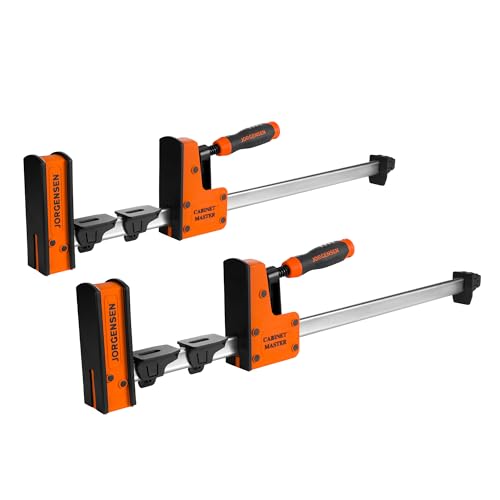
- ✓ High clamping force
- ✓ Quick jaw-to-spreader flip
- ✓ Soft Landing System
- ✕ Heavier than lightweight clamps
- ✕ Price premium per pair
| Clamp Length | 24 inches |
| Clamping Force | Up to 2200 lbs |
| Clamp Type | Parallel bar clamp with sliding jaw |
| Pack Size | 2-Pack |
| Conversion Feature | Sliding jaw reversible to a spreader (tool-free) |
| Accessories Included | 2-in-1 glue separator and clamp stand |
You’ll notice it the moment you lift the JORGENSEN 24-inch parallel clamp—the steel bar feels rigid, with barely any give as you line up your panel. I tucked a glued cabinet drawer front between the jaws and a spare plywood test panel, and the 2200-lb force held everything perfectly square as the glue set.
The sliding jaw is smooth and responsive, and flipping it into a spreader took seconds with no tools. That quick conversion saved me from fighting misalignment mid-glue-up, especially when clamping drawers with narrow gaps.
The soft-grip handle gave me confident control, even when I tightened for a long glue-up session.
The lever action is surprisingly quiet, with a reassuring clack as the screw threads bite in. I appreciated the quick-release trigger for repositioning without losing alignment; it felt safer than wrestling flared panels back into place.
The Soft Landing System is a subtle win, keeping the jaw from dropping when I carried the clamp vertical. It’s a small detail, but it means you won’t drop a glued run or mar a surface while moving from station to station.
The included 2-in-1 glue separator and clamp stand is handy, lifting the bar off the work surface so glue remains clean and uncluttered.
Replacement jaw pads are a smart touch, offering added protection and better glue resistance for future projects. Overall, this pair feels built for real woodworking rather than light-duty tasks, delivering consistent pressure and dependable accuracy on glue-ups, cabinet assemblies, and cutting-board prep.
JORGENSEN 36-Inch Parallel Bar Clamps Set (2) – 2200 lbs

- ✓ Strong clamping force
- ✓ Quick-reverse spreader
- ✓ Soft landing system
- ✕ Heavier than basic clamps
- ✕ Takes a bit of space
| Clamp Length | 36 inches |
| Clamping Force | Up to 2200 lbs |
| Bar Construction | Rigid steel bar |
| Jaw/Spreader Configuration | Sliding jaw reversible to spreader (tool-free conversion) |
| Soft-Grip Handle | Ergonomic soft-grip handle for high-torque tightening |
| Included Accessories | 2-pack clamps with 2-in-1 glue separator and clamp stand; replacement jaw pads available |
A gentle click and a confident snap—that’s how these JORGENSEN 36-inch parallel clamps greeted me out of the box. The 2-pack feels substantial, with a rigid steel bar that doesn’t bend under pressure.
I could see the 2200 lbs rating in practice when I tightened across a glued panel and watched the surface stay perfectly flat.
The sliding jaw moves smoothly, and the quick-reverse feature converts to a spreader in seconds without tools. That versatility is perfect for glue-ups where you need to coax two boards apart or hold a drawer face square while glue dries.
The soft-grip handle is a real upgrade, giving you torque without fatiguing your hands.
Setups are cleaner thanks to the Soft Landing System. No more jaw crashing to the floor when you carry these vertically, which is a small but meaningful improvement in a busy shop.
The included 2-in-1 glue separator and clamp stand lift the bar off the work surface, helping keep glue residue to a minimum and protecting your stuff.
During actual use, the precision felt consistent from corner to corner. Replacement jaw pads are a nice touch if you ever need to protect an delicate veneer or reduce marring.
It’s easy to align pieces for a perfect glue joint, and the clamps stay true as you re-check both sides.
If you’re doing cabinet work or a wide panel glue-up, these clamps hold their line well without bowing. The two-pack gives you enough spread to handle larger assemblies while staying manageable in a mid-size shop.
They’re not feather-light, but they feel built to last through real woodworking cycles.
Overall, they’ve become go-to clamps for glue-ups that demand consistent pressure and easy position changes. You’ll appreciate the blend of rigidity, safety features, and practical accessories in everyday projects.
2026 Upgrade Fits 5-1/2″ to 16″ Wide Woodworking, 19″ Panel

- ✓ Even 4-way pressure
- ✓ Fast solo setup
- ✓ Wide panel range
- ✕ Takes space in small shops
- ✕ Slightly heavy
| Frame | Lightweight steel frame |
| Material | High-quality materials for durability |
| Dimensions | Compact design fits most spaces |
| Weight | Lightweight and portable |
The moment you clamped a 12″ panel and felt the 4-way pressure bite in evenly from every direction, you’ll know this clamp system isn’t playing around. No more chasing warps after the glue dries—this setup keeps panels flat and flush with surprising consistency.
You’ll notice the alignment benefits right away when you slide the pieces together and the joints meet cleanly.
Setup is definitely the standout. You’ll appreciate the quick adjustment handles and the way the clamps lock into place with a confident click.
Working solo? It feels designed for you, with steady pressure that doesn’t wander as you tighten.
The powder-coated steel looks rugged enough for a busy shop, yet the feet stay steady on a slick workbench.
Width versatility shines once you line up a cabinet panel. The 5-1/2″ to 16″ range covers most glue-ups you’ll encounter, and the 1/2″ to 1-1/2″ thickness spec matches a lot of cutting boards and drawer fronts you’ll build.
It’s refreshing to have a tool that doesn’t fight you during a one-person glue-up, letting you nudge for fine alignment without losing clamped pressure.
In real use, the 4-way system means fewer tweaks mid-glue and less sanding afterward. You’ll still run through your normal process—apply glue, position panels, then clamp—but with less guesswork about whether a seam will gap or drift.
It’s the kind of helper that earns its keep after a dozen glue-ups in a week.
Overall, this ZXCTETO clamp system delivers repeatable results, especially when you’re juggling multiple pieces or tight tolerances. If you value flat panels and efficient setup, this is worth a serious look.
What Types of Clamps Are Best for Glue Up Projects?
The best clamps for glue up projects include several types designed to provide even pressure and secure joints effectively.
- Bar Clamps: These clamps are versatile and come in various lengths, making them ideal for larger glue ups. They have a long bar that helps distribute pressure evenly across wide surfaces, ensuring a strong bond without warping the material.
- Pocket Hole Clamps: Designed specifically for pocket hole joints, these clamps hold pieces at a precise angle, allowing for accurate assembly. They are particularly beneficial when working with cabinetry or furniture projects where hidden joints are common.
- Pipe Clamps: Utilizing standard pipes for the clamping mechanism, these clamps can be adjusted to accommodate various widths and lengths. They provide significant clamping force and are perfect for large panels or multiple boards glued together, ensuring a tight bond.
- Corner Clamps: Ideal for assembling frames and boxes, corner clamps hold pieces at a 90-degree angle. They help ensure that joints are square while the glue sets, which is crucial for maintaining the structural integrity of the assembly.
- F-Style Clamps: These clamps offer a good balance between strength and ease of use. They have a quick-release feature, allowing for rapid adjustments and are particularly effective for smaller glue ups where precise pressure is needed.
- Band Clamps: Designed for irregular shapes and large assemblies, band clamps wrap around the project and apply even pressure from all sides. They are especially useful for gluing curved or odd-shaped items, as they conform to the shape of the workpiece.
Which Clamps Are Most Effective in Woodworking for Glue Application?
The best clamps for glue up in woodworking include a variety of types designed to provide strong, even pressure during the drying process.
- Bar Clamps: These are versatile and widely used in woodworking projects. They consist of a long metal bar with a movable arm that allows for easy adjustment to fit various widths, making them ideal for gluing large panels or frames.
- Pipe Clamps: Similar to bar clamps but using a pipe as the bar, these clamps are often more affordable and can be customized to different lengths. They provide strong, even pressure and are particularly useful for larger glue-ups, such as tabletops or cabinets.
- F-Clamps: These clamps feature a fixed arm and a sliding arm, allowing for quick adjustments. They are effective for holding pieces tightly together while the glue sets, and their lightweight nature makes them easy to handle during the application process.
- Corner Clamps: Ideal for ensuring square joints, corner clamps hold pieces at a 90-degree angle. They are particularly useful for assembling frames and boxes, providing stability while the glue dries.
- Band Clamps: These consist of a strap that wraps around the project and tightens to apply even pressure across the entire surface. They are especially beneficial for irregularly shaped pieces or when clamping multiple joints simultaneously, ensuring a uniform bond.
- Spring Clamps: While not as powerful as other types, spring clamps are great for quick and easy setups. They are useful for holding smaller pieces in place during the glue application, making them a handy addition to the toolbox.
- Parallel Clamps: These provide a wider clamping surface and maintain parallel pressure across the workpiece. They are particularly useful for delicate projects or when working with thin materials, as they reduce the risk of bowing or misalignment.
What Advantages Do Parallel Clamps Offer for Glue Up?
Parallel clamps are highly regarded in woodworking for their exceptional performance during glue-ups due to several advantages:
- Even Pressure Distribution: Parallel clamps apply uniform pressure across the entire surface of the workpiece, ensuring that glue is spread evenly without gaps or misalignments.
- Stability and Control: The design of parallel clamps allows for greater stability, preventing the workpiece from shifting during the clamping process, which is crucial for maintaining the integrity of joints.
- Versatility: These clamps can accommodate a wide range of material thicknesses and shapes, making them ideal for various woodworking projects, from panels to frames.
- Ease of Use: Parallel clamps are typically easier to adjust and operate, often featuring a quick-release mechanism that allows for faster setup and adjustments during glue-ups.
- Durability: Most parallel clamps are constructed from robust materials, ensuring they can withstand repeated use without warping or losing their clamping force over time.
Even Pressure Distribution: By providing a large surface area for contact, parallel clamps ensure that pressure is distributed evenly over the entire joint, reducing the risk of glue squeeze-out and ensuring a strong bond.
Stability and Control: Their design minimizes the movement of the workpiece while clamped, allowing woodworkers to achieve precise alignments, which is especially important for tight-fitting joints.
Versatility: The adjustable jaws of parallel clamps can handle different widths and shapes, making them suitable for various projects, whether you’re working with thick boards or delicate frames.
Ease of Use: The intuitive design of parallel clamps often includes features like sliding arms and quick-release levers, which simplify the clamping process, saving time and effort during glue-ups.
Durability: Built from high-quality materials, parallel clamps are made to endure the rigors of woodworking, ensuring they remain effective and reliable over many projects.
Why Should You Consider Pipe Clamps for Your Glue Projects?
You should consider pipe clamps for your glue projects because they provide excellent pressure distribution and strength, which are crucial for achieving a strong bond in woodworking.
According to a study published in the Journal of Wood Science, effective clamping pressure can significantly influence the quality of adhesive bonds in wood. The research indicates that uneven pressure can lead to gaps and weak spots in the glued joint, potentially compromising the integrity of the entire project. Pipe clamps are designed to apply uniform pressure across the surface, which enhances the adhesion process and results in a more durable bond.
The underlying mechanism for this effectiveness lies in the way pipe clamps distribute force. Unlike other clamp types that may concentrate pressure at specific points, pipe clamps utilize a long bar that allows for even pressure across a wider area. This uniformity reduces the likelihood of damaging the wood surface and ensures that the adhesive spreads evenly throughout the joint. Additionally, the adjustable nature of pipe clamps allows woodworkers to easily accommodate various project sizes, making them a versatile choice for different glue-up scenarios.
What Features Should You Look for When Choosing Glue Up Clamps?
When choosing glue up clamps, several key features can significantly impact their performance and usability.
- Clamping Pressure: The ability to apply sufficient clamping pressure is crucial for a strong bond. Look for clamps that can exert even pressure across the surface to ensure all joints are tightly secured without the risk of damage to the workpieces.
- Size and Capacity: The size and capacity of the clamps should match the dimensions of your projects. Consider the maximum opening and length of the clamps to accommodate various sizes of wood or materials you plan to work with.
- Material Construction: Clamps made from durable materials like steel or fiberglass-reinforced plastic offer better longevity and strength. High-quality materials also resist warping and ensure consistent performance over time.
- Ease of Use: Look for clamps that are user-friendly, featuring quick-release mechanisms and comfortable grips. Clamps that are easy to adjust and operate can save time and reduce frustration during the gluing process.
- Versatility: Some clamps come with features that allow them to be used for various applications, such as edge gluing or panel clamping. Versatile clamps can save you money and space, as they can be adapted for different projects.
- Stability and Alignment: Clamps that provide stable support and help align the pieces correctly are essential for achieving accurate results. Features like padded jaws can prevent slipping and ensure that the materials remain aligned during the curing process.
- Weight and Portability: If you frequently move your workspace or need to transport your clamps, consider their weight and portability. Lightweight clamps are easier to handle and store, making them more convenient for on-the-go projects.
How Can You Ensure Proper Usage of Clamps in Glue Up Techniques?
Ensuring proper usage of clamps in glue-up techniques is essential for achieving strong and precise joints in woodworking projects.
- Type of Clamps: Choosing the right type of clamp is crucial for effective glue-ups. Common types include bar clamps, pipe clamps, and corner clamps, each designed for specific applications and providing varying levels of pressure and stability during the drying process.
- Pressure Distribution: Applying even pressure across the joint is vital. Using clamps that distribute pressure uniformly helps to avoid warping or misalignment of the glued pieces, ensuring a tight and secure bond.
- Placement of Clamps: The strategic placement of clamps can significantly affect the glue-up. Positioning clamps close to the joint and in multiple locations can help hold pieces in alignment while providing adequate pressure, preventing any gaps from forming as the glue cures.
- Clamping Time: Understanding the appropriate clamping time based on the glue being used is essential. Different adhesives have varying setting times, and releasing clamps too early can compromise the bond, while leaving them on too long can lead to surface damage.
- Cleanup of Excess Glue: Managing excess glue during the clamping process is important for maintaining a clean project. Using a damp cloth to wipe away any squeeze-out before it dries can save time and effort in sanding and finishing later.
- Material Compatibility: Ensuring that the clamps are compatible with the materials being glued is critical. Using clamps that can accommodate the thickness and type of wood, as well as any additional finishes, will help in achieving better results without damaging the materials.
What Common Mistakes Should Be Avoided During Glue Up?
Common mistakes during glue up can significantly affect the quality of your final project.
- Inadequate Clamping Pressure: Failing to apply sufficient pressure can lead to weak joints that do not hold together properly. It’s essential to use clamps that provide even pressure across the surface to ensure a tight bond.
- Using the Wrong Type of Glue: Each glue has its own properties and ideal applications; using the wrong type can compromise the integrity of your joint. For example, wood glue is great for porous materials, while epoxy might be necessary for non-porous surfaces or heavy-duty applications.
- Not Preparing Surfaces Properly: Any dirt, oil, or old finish on the surfaces can prevent a strong bond from forming. It’s important to clean and, if necessary, sand the surfaces to ensure they are smooth and free of contaminants before applying glue.
- Ignoring Open Time: Every glue has a specific open time during which it can be applied before it starts to set. Failing to adhere to this timeframe can result in a poor bond or dried glue that doesn’t hold the pieces together effectively.
- Overusing Glue: Applying too much glue can create a mess and lead to glue squeeze-out that interrupts the joint’s alignment. A thin, even layer of glue is usually sufficient to achieve a strong bond without excess overflow.
- Not Using Enough Clamps: Under-clamping can result in uneven pressure and weak joints. Ensuring you have enough clamps to cover the entire joint area is vital for achieving a consistent and strong bond across all glued surfaces.
- Neglecting to Check Alignment: During the clamping process, it’s easy to lose alignment between the pieces. Double-checking and making necessary adjustments before the glue sets can save you from misaligned joints that may require extensive repair.
- Rushing the Process: Hurrying through the glue-up can lead to mistakes and oversight. Taking the time to properly prepare, apply, and clamp will enhance the quality of the final product and help avoid preventable issues.